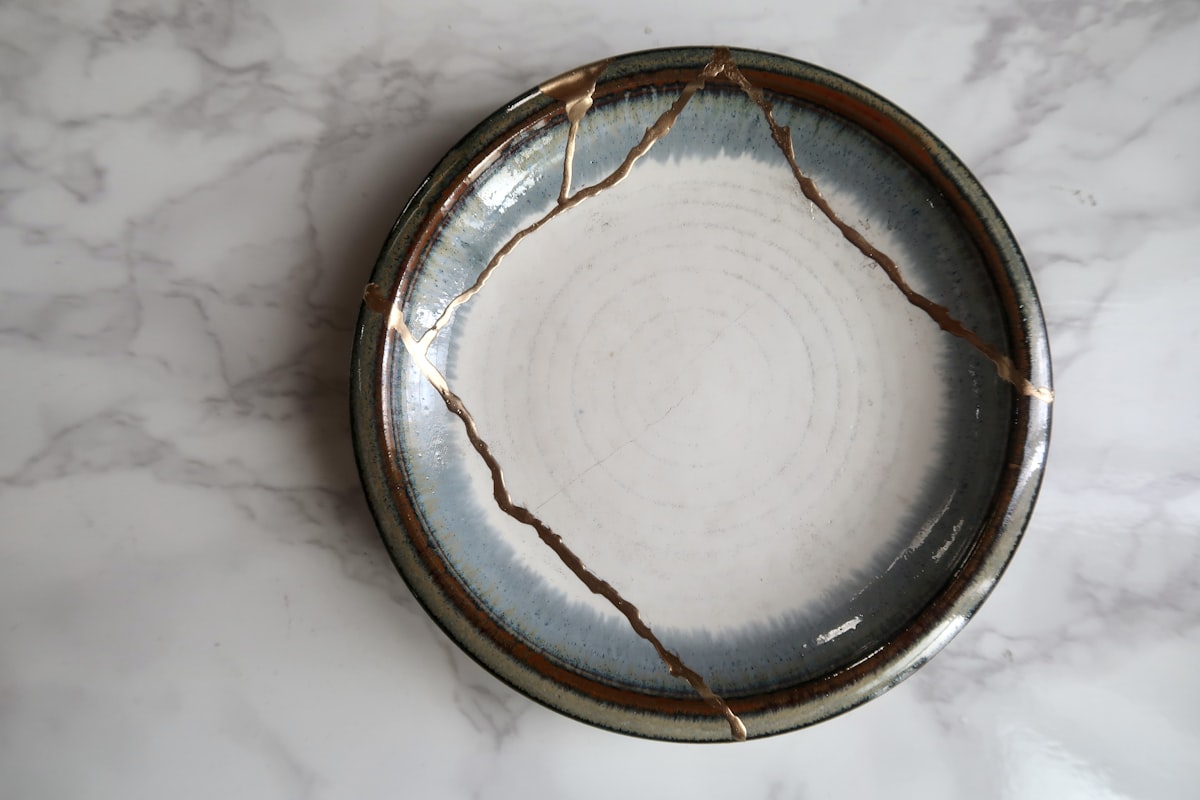
Drop a favourite bowl and your instinct is to make the repair vanish — invisible glue, a hidden seam, the break denied. Kintsugi, the Japanese art of repairing ceramics with lacquer and powdered gold, takes the opposite view. It draws the break in shining metal, so that the mended bowl carries a bright golden map of everywhere it once shattered. The repair becomes the most beautiful thing about it.
How it is actually done
Traditional kintsugi is slow and unglamorous before it is golden. The fragments are rejoined with urushi, a natural lacquer made from tree sap, which is strong, food-safe when cured, and notoriously slow to harden — pieces rest for days or weeks between stages, in humid conditions the lacquer prefers. Once the join is solid, the seam is dressed with more lacquer and dusted with real gold (or silver, or brass) so the line catches the light. The result is durable enough to use, not merely to display.
It is exacting work, which is part of the point. You are not patching the bowl; you are giving it a second, deliberate life.
“The crack is not the flaw in the object. It is a chapter in its history, and history is worth gold.”
The idea underneath the gold
Kintsugi is usually linked to wabi-sabi, the aesthetic that finds beauty in imperfection, age and wear. Both push against the modern assumption that damage lowers worth and that newness is the ideal. A kintsugi bowl insists the opposite: that an object which has been broken and mended carefully is richer than one that has never been tested. The breakage is integrated rather than erased.
There is a reason the technique has travelled far beyond ceramics studios in recent years, turning up as a metaphor in everything from psychology to design talks. The image is irresistible — that what is broken can be repaired so well it becomes more valuable than before.
Trying it yourself
You do not need real gold or genuine urushi to begin. Beginner kits use food-safe epoxy and mica or imitation gold powder, and they are a forgiving way to learn the logic of the craft: clean breaks, patient joins, a steady hand tracing the seam. Start with a plain bowl you have already broken, or one bought cheaply to break on purpose. Your first attempt will be clumsy — and, in the spirit of the craft, that is entirely allowed.