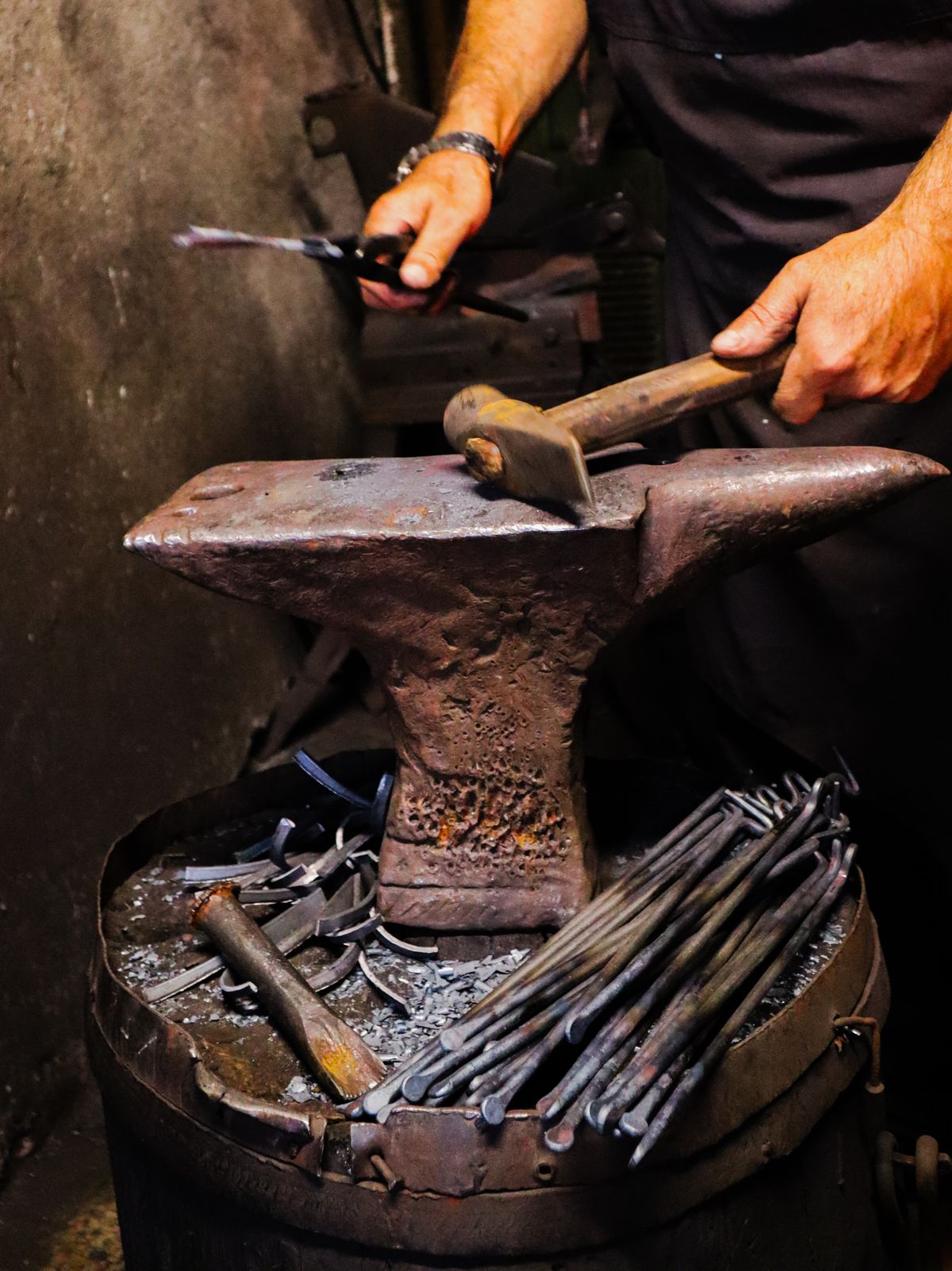
The forge sits at the edge of a Tuscan village that most maps don't bother naming. Inside, the air is warm and smells of coke and scale, and Alessandro Ferro is drawing out a bar of iron that glows the colour of an apricot. He strikes it in an easy rhythm, turning it a quarter each time, and the bar lengthens and squares as if it were soft clay rather than metal.
"People think strength," he says, not looking up. "It is not strength. It is knowing when."
Reading heat by eye
The whole craft, Ferro will tell you, lives in the colour of the steel. Too cold and it cracks under the hammer. Too hot and it crumbles, the grain ruined. The working window for many tasks is narrow, and a smith has perhaps seconds before the piece cools out of it and goes back in the fire. He judges all of this without a single instrument, by a vocabulary of colours his great-grandfather used the same words for: cherry, orange, straw, white.
It is knowledge that does not transfer through a screen. You cannot learn the moment from a video, because the moment is different for every bar, every fire, every day. You learn it by ruining a great deal of iron next to someone who ruins very little.
“A machine can make a thousand identical things. It cannot make one thing that fits the hand of the person who asked for it.”
Alessandro Ferro
Why the trade nearly died
For most of the twentieth century, industry did to blacksmithing what it did to many trades: made it slower and more expensive than the factory alternative. Gates, hinges, tools and brackets that a smith once forged by hand could be stamped out by the thousand. The village smithies closed one by one. Ferro's own master worked the last years of his life mostly repairing farm machinery, the ornamental work having dried up.
What saved the trade, where it survived at all, was a turn back toward the handmade: clients who want a railing or a set of fire tools that no one else owns, restorers who need period ironwork repaired in period ways, and a younger generation drawn to the physical honesty of the work.
Passing it on, finally
For years Ferro worked alone. Recently he took on an apprentice, a woman in her late twenties who left an office job to learn the fire. He is a demanding teacher and says so cheerfully. The first months were almost entirely sweeping, tending the fire, and watching, the way his own training began.
"She asked me once why she couldn't just start hammering," he says. "I told her: you will hammer for the rest of your life. First you learn to see." He nods at the apricot-coloured bar cooling on the anvil. "Now she sees it. That is the part that almost disappeared."